 Silence and comfort
Sound insulation is a feature that directly affects quality of life. Being able to isolate oneself from unwanted noises means, in practice, peace of mind for householders, privacy and less risk of conflict with neighbours. In order to make the house our refuge, the walls should effectively reduce the sound between the different rooms.
Technical dictionary
Would you like to know more about sound insulation or what a declaration of performance contains? Take a look at our technical glossary.
Acoustic insulation
RW – weighed specific acoustic insulating power coefficient
RA,1 – specific acoustic insulating power assessment coefficient
RA,2 – specific acoustic insulating power assessment coefficient
RA,1,R – designed specific acoustic insulating power assessment coefficient RA,1
R’A,1 – specific acoustic insulating power approximate assessment coefficient R’
K – flanking sound transmission
Acoustic insulation
Acoustic insulation – partition capability of ensuring protection against noise. As regards plasterboards, Acoustic insulation is equated with protection against air-carried sounds. Acoustic insulation is expressed in decibels [dB], mainly using the RW, RA,1, RA,2, R’A,1 and R’A,2 coefficients.
The basic requirements regarding acoustic insulating power are defined in the PN-B 02151-3:1999 standard. Presently, work is underway to include the new version of the PN-B 02151-3:2015 standard in the Ordinance on technical conditions to be met by buildings and their locations.
RW – weighed specific acoustic insulating power coefficient
RW – weighed specific acoustic insulating power coefficient, expressed in [dB]. It is used to generally assess a partition according to requirements applicable in the majority of EU countries. A value obtained in a laboratory test performed on a partition. The value corresponds to the 500 Hz sound frequency on a reference curve from a acoustic insulating power chart for a partition.
RA,1 – specific acoustic insulating power assessment coefficient
RA,1 – specific acoustic insulating power assessment coefficient taking into account the spectral adaptation coefficient C (RA,1 = RW + C), expressed in [dB]. A value obtained in a laboratory test performed on a partition. A coefficient corresponding to acoustic insulating power protecting against medium- and high-frequency air-carried sounds characteristic for e.g. social noise generated by people. This coefficient is used mainly to assess the acoustic insulating power of internal partitions.
RA,2 – specific acoustic insulating power assessment coefficient
RA,2 – specific acoustic insulating power assessment coefficient taking into account the spectral adaptation coefficient Ctr (RA,1 = RW + Ctr), expressed in [dB]. A value obtained in a laboratory test performed on a partition. A coefficient corresponding to the acoustic insulating power protecting against low-frequency sounds characteristic for, e.g. external noise (heavy street traffic).
This coefficient is used mainly to assess the acoustic insulating power of external partitions.
RA,1,R – designed specific acoustic insulating power assessment coefficient RA,1
This coefficient is determined by decreasing the specific acoustic insulating power coefficient RA,1 by an allowance for performance errors (RA,1,R = RA,1 – 2 dB). The coefficient is used to assess partition walls in multi-family building flats and to estimate the acoustic insulating power R’.
R’A,1 – specific acoustic insulating power approximate assessment coefficient R’
R’A,1 – specific Acoustic insulation approximate assessment coefficient R’ taking into account the spectral adaptation coefficient C. The R’A,1 coefficient takes into account the Acoustic insulation protecting against medium- and high-frequency air-carried sounds achieved in given application conditions. R’A,1 thus takes into account the flanking sound transmission K. The value of the coefficient is obtained during a field acoustic test or estimated in calculations. It is used mainly to assess the acoustic insulating power of the majority of internal partitions.
K – flanking sound transmission
K – flanking sound transmission, i.e. an allowance for the sound transmitted by neighbouring partitions (ceiling, adjacent walls). The K allowance depends on the partition geometry, method of joining it with other partitions and the type of adjacent partitions. Calculating the flanking sound transmission is usually a complex task for which an acoustician should be employed.
Applicable requirements for the required acoustic insulating power coefficients are defined in the PN-B 02151-3:1999 standard (presently work has been underway to include the new version of the PN-B 02151-3:2015 in the Ordinance on the technical conditions for buildings and their location).
Video tutorials
Find out how to properly install a sound-insulating plasterboard cladding. Check out our VIDEO tutorials, as well as product tests and expert recommendations.
Recommended products for sound insulation
Check out the products in the Norgips range that you can use in the acoustic insulation solutions we recommend.
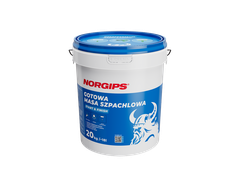
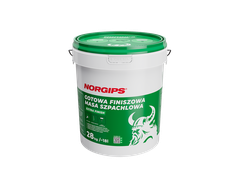
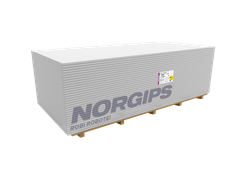
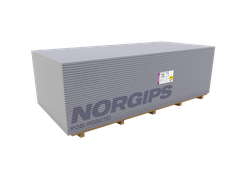
Norgips solutions with improved sound insulation
Do you want to know what Norgips acoustic insulation solutions consist of? Once you have selected the system you are interested in, you will receive a complete set of information and drawings and you can calculate the material consumption in our calculator.
Acoustic insulation effectiveness increase
Here you will find practical advice and information on products that improve sound insulation and their applications, as well as how to build non-standard plasterboard lining elements.. We will help you get the job done quickly and efficiently.
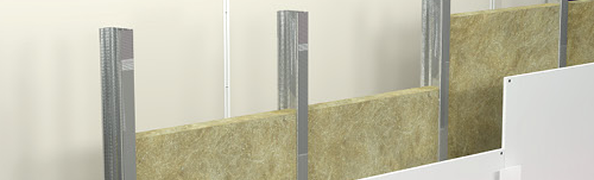
Duo hybrid solutions from Norgips are a response to the increasing awareness of people renovating their flats or houses. Good soundproofing indoors is something to which special attention is paid. Everyone is looking for effective and relatively ine…
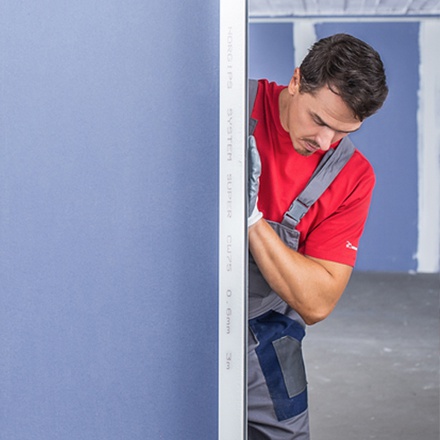
There are many advantages to using Acoustic Super type DFH2IR board in partition and curtain wa…
How to make a partition wall correctly? What products should be used in loft? How much does the plasterboard weigh? Our technical advisors can answer these and your other questions.

A selection of downloads and material consumption calculations from our website can be included in the document folder.
Click'To folder' on any document or calculation.
With the document folder you can easily prepare documentation for your investment including:




