


Description
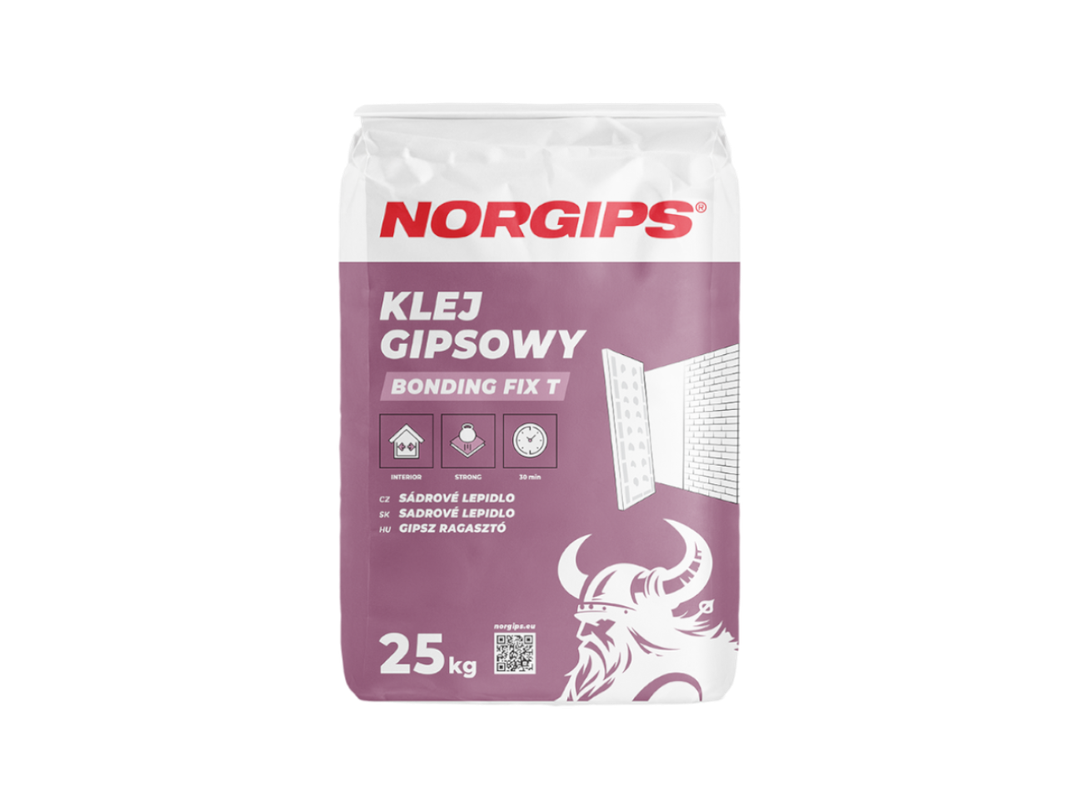
Gypsum adhesive for plasterboards and insulating materials, intended for gluing gypsum plasterboard lining to vertical surfaces located inside buildings.
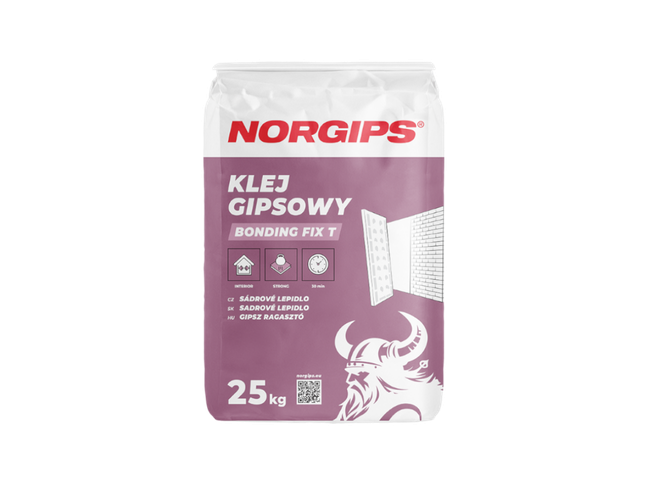
Gypsum adhesive for plasterboard and insulation materials
Gypsum adhesive for plasterboards and insulating materials, intended for gluing gypsum plasterboard lining to vertical surfaces located inside buildings.
Bonding plasterboards or insulation materials on substrates based on concrete, gypsum, lime cement, limestone sand, ceramic materials or cellular concrete.

General-purpose adhesive

High substrate adhesion

Suitable for increased humidity environments (bathrooms, kitchens)
Easy processing
Extended working time
Type
Gypsum adhesive compliant with EN 14496:2017
Reaction-to-fire performance
A1 – completely non-combustible
Working time
Min. 30 minutes
Application temperature
+5°C to 25°C
Adhesiveness
> 0,06 Mpa
Consumption
5 kg/m2 (gluing 12.5 mm plasterboards on adhesive spots)
6 kg/m2 (gluing 9.5 mm plasterboards on adhesive spots)
Shelf life
12 months
Packaging
Bag 20 kg, 25 kg, 30 kg
SUBSTRATE PREPARATION
The substrate should be dry and in sound condition and free of grease, dirt, dust and loose particles. Depending on the substrate absorption rate and adhesiveness, prime the substrate with the NORGIPS POROGRUNT or NORGIPS BETOGRUNT agent before sticking plasterboards.
ADHESIVE PREPARATION
Pour the gypsum adhesive into a vessel filled with clean water in a ratio of 2 kg of adhesive per 1.1 litres of water.
After 3 minutes, mix the obtained compound manually or with a slow-speed mixer, until a homogeneous consistency is obtained.
The mixed adhesive should be used up within 30 minutes (mechanical mixing) or 45 minutes (manual mixing).
The use of dirty tools can shorten the working time of the mixed compound.
APPLICATION – DRY LINING USING GYPSUM PLASTERBOARD
Distribute the adhesive on the backside of the plasterboard, along its edges . On the remaining surface, lay on adhesive spots with a diameter of about 10 cm, in two rows, with a spacing of 30-35 cm. The thickness of the adhesive spots should be at least 1.5 cm. The adhesive can also be applied with a 10 mm toothed trowel.
Then place the plasterboard vertically on 1-1.5 cm thick wedges and press it against the wall. After the setting has started, do not change the position of the plasterboards.
Finish the plasterboard joints with a basic compound up to Q1 surface quality level. Then, the joint is suitable for finishing at surface quality level Q2, Q3 or Q4 (see related products), as required.
ADDITIONAL INFORMATION
News
Find out about current events and new products from Norgips
on 4 September, Peamco organised an Open Day at its Leszno warehouse. More than 20 exhibitors participated. It was an excellent opportunity for investors and contractors to learn about the range of building materials and services on offer.
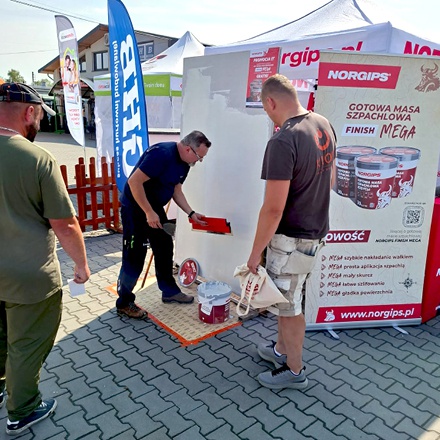
GHB Group company Kantor organised a Construction Industry Fair on 13 September 2025 on the pre…
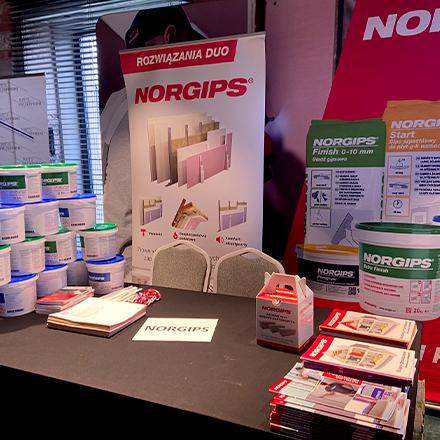
This year, on 5-7 April, the National Construction Fair organised by the Handlo-Budowa Group to…
How to make a partition wall correctly? What products should be used in loft? How much does the plasterboard weigh? Our technical advisors can answer these and your other questions.

A selection of downloads and material consumption calculations from our website can be included in the document folder.
Click'To folder' on any document or calculation.
With the document folder you can easily prepare documentation for your investment including:


